
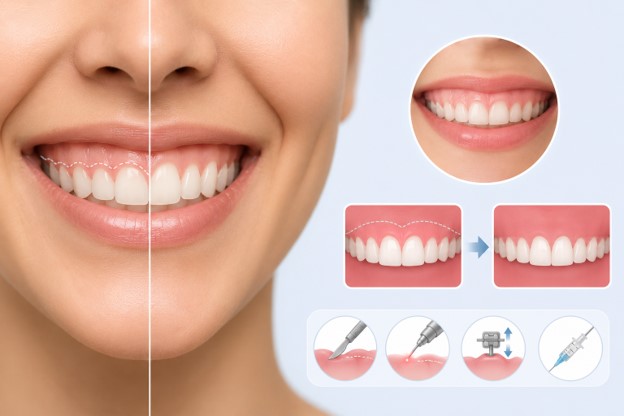

A smile should feel effortless and balanced. When excessive gingival display occurs, more gum tissue becomes visible above the upper teeth. Clinically, this is referred to as a gummy smile.
At the office of Dr. Nooshin Ghayoumi, patients often describe it as something they “have always had.” Yet careful evaluation frequently reveals multiple contributing factors rather than a single fixed trait.
What Is Considered a Gummy Smile?
Clinical references often describe a gummy smile when excessive gingival display is noticeable during smiling.
A small degree of gingival exposure is entirely normal. Smiles do not rely on teeth alone for esthetics.
This leads to a key diagnostic question. Is excess gingival tissue actually present, or does another factor simply make normal tissue appear more prominent?
Why Do Some People Show More Gum Tissue When Smiling?
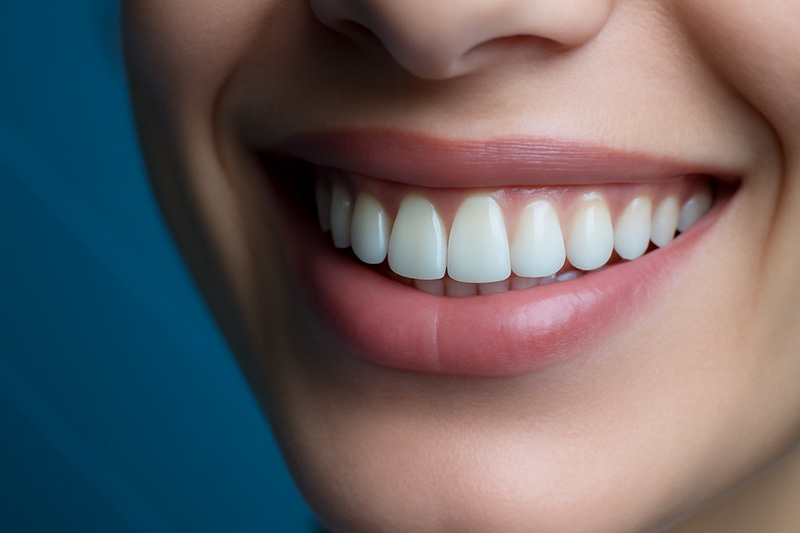
Short or Worn Teeth
Tooth size plays an important role in smile balance. Some individuals present with naturally shorter teeth, while others develop reduced clinical crown height due to enamel wear over time.
As tooth structure appears smaller, surrounding gingival tissue becomes more visually dominant. This results in the appearance of increased gingival display without an actual increase in gingival tissue volume.
Excess Gum Coverage
In certain cases, the gingival tissue extends over more tooth surface than expected. This condition is often associated with altered passive eruption (APE), a diagnosis that requires clinical and radiographic evaluation.
The teeth themselves usually maintain normal anatomical size. The issue lies in incomplete exposure during eruption and development, leaving more crown covered by soft tissue.
Crown lengthening procedures commonly address this pattern by re-establishing proper tooth-to-gum ratios and biologic width.
Upper Lip Movement
Lip dynamics significantly influence smile esthetics. Some patients demonstrate increased elevation of the upper lip during smiling, which exposes more gingiva than average.
At rest, facial proportions may appear entirely balanced. During smiling, however, the hyperactivity of upper lip musculature changes the display pattern and reveals additional gum tissue.
The discrepancy becomes visible only in motion, not at rest.
Jaw Position
Skeletal relationships also contribute in certain cases. Vertical maxillary excess is a skeletal condition characterized by excessive vertical growth of the maxilla.
This anatomical variation can result in generalized gingival display across the entire smile arc. The presentation tends to be more uniform rather than localized.
Treatment planning depends on severity and may involve orthodontic intervention, surgical correction, or a combined approach.
Is a Gummy Smile a Medical Problem?
In most situations, a gummy smile does not represent a medical disease. It does not typically interfere with oral function or overall dental health.
Still, clinicians sometimes observe accompanying conditions, including uneven gingival margins, bite discrepancies, tooth wear patterns, gingival inflammation, or orthodontic imbalance.
These findings reinforce the importance of full diagnostic evaluation before any treatment decision.
How Dentists Diagnose a Gummy Smile
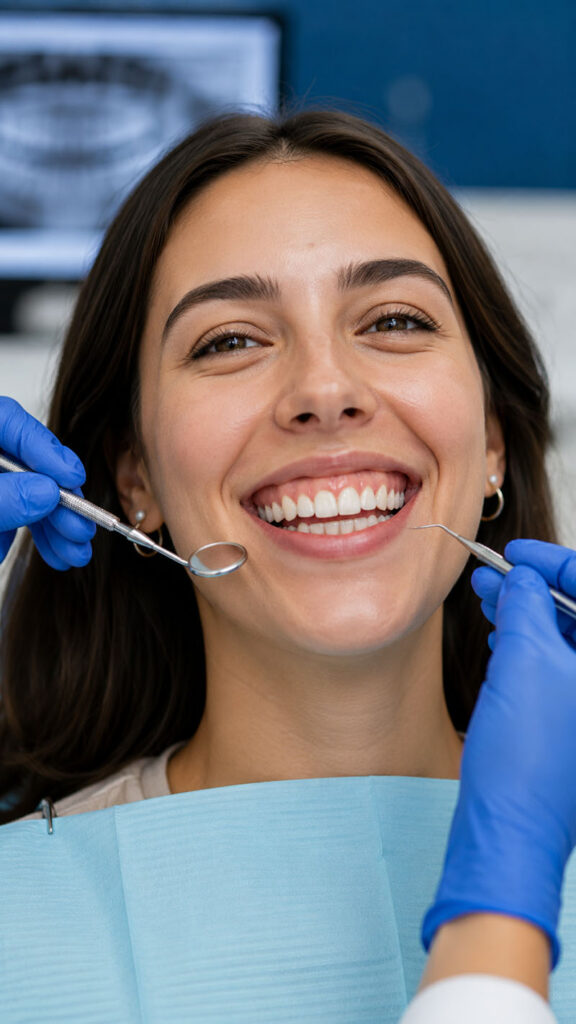
Assessment extends far beyond visual inspection. A periodontist evaluates both soft tissue and skeletal components to identify the true source of excessive gingival display.
Key factors include tooth length and proportion, gingival symmetry, lip mobility during smiling, jaw position, occlusal relationships, and overall smile line harmony with facial structure.
Digital imaging and clinical measurements often support these findings, allowing precise treatment planning.
During consultation, a common patient concern arises: whether surgery is always required or if less invasive options exist.
The answer depends entirely on etiology. For example, neuromodulation with Botox may reduce upper lip elevation in selected cases, but it cannot correct structural problems such as altered eruption patterns or skeletal discrepancies.
Why Treatment Depends on the Cause
A gummy smile can have several different causes, so no single approach applies to every patient. The same visual concern may come from excess gum coverage, short-looking teeth, upper lip movement, tooth position, jaw position, or a combination of these factors.
When excess gum coverage is the main factor, periodontal procedures may be discussed to improve the visible tooth-to-gum relationship. When upper lip movement contributes to the display, soft-tissue or muscle-related options may be considered. If tooth position or bite relationships play a role, orthodontic evaluation may be part of the diagnostic process.
In cases involving skeletal discrepancies such as vertical maxillary excess, a broader orthodontic or surgical evaluation may be necessary. The appropriate direction depends on the severity of the finding, the patient’s facial structure, and functional considerations.
Because the cause is not always obvious from appearance alone, diagnosis should come before any decision about correction. Patients comparing available options can review dedicated gummy smile treatment information after the source of the concern has been identified.
Can Gum Display Change Over Time?
Long-term stability depends on both underlying cause and treatment modality. When the primary etiology is accurately addressed, outcomes often remain stable over extended periods.
In other situations, changes in muscular activity, occlusal forces, or periodontal health may subtly influence long-term appearance. Maintenance of gingival health and regular dental follow-up support treatment stability over time.
When Should You See a Periodontist?
An evaluation becomes appropriate when excessive gingival display affects smile confidence, tooth proportions appear reduced, asymmetry develops after orthodontic treatment, or uncertainty exists regarding the origin of the concern.
At the office of Dr. Nooshin Ghayoumi, evaluation prioritizes biologic balance and facial harmony, aiming for outcomes that integrate naturally with each patient’s individual anatomy. For patients considering their options, learn more about gummy smile treatment in Orange County.