
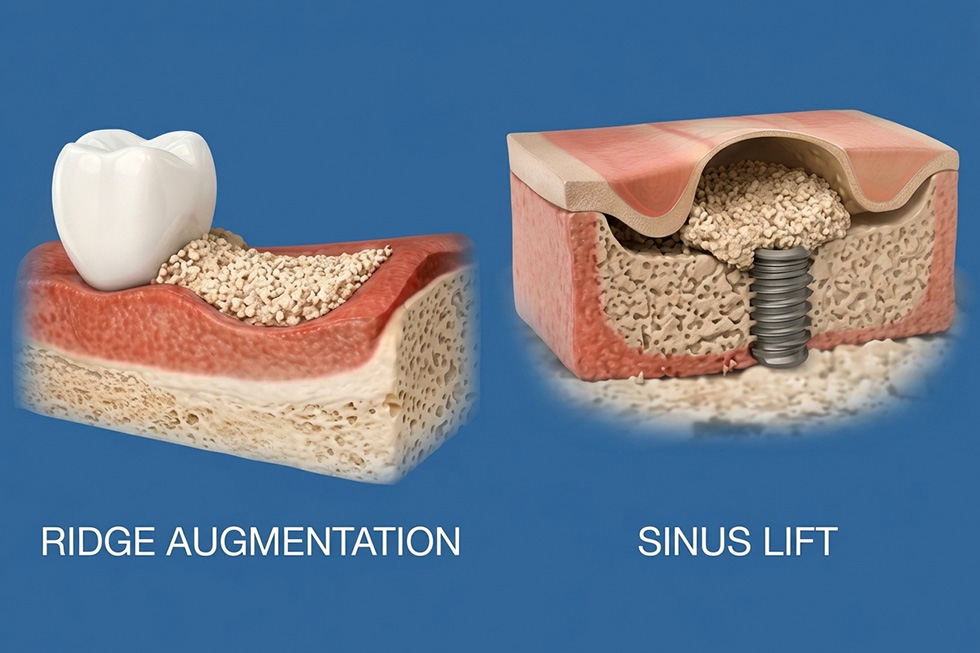

Dr. Nooshin Ghayoumi often meets patients who are excited about dental implants until imaging shows there isn’t enough bone in the upper or lower jaw to support them. That’s where sinus lifts and ridge augmentation come in. These procedures rebuild the missing bone, creating a solid foundation for implants to anchor securely and for crowns to look completely natural.
While the terminology may sound complex, most patients are surprised by how straightforward the experience actually is.
Common questions come up time and again: Is the procedure painful? How long does it take before implants can be placed? Will the new bone last over time? This guide walks through each step in clear, simple terms so expectations align with reality from the very beginning.
When Bone Loss Makes Sinus Lift or Ridge Augmentation Necessary?
Teeth naturally stimulate the jawbone every time you chew. When a tooth is lost, that stimulation stops and the bone begins to shrink. In the upper back jaw, the maxillary sinus gradually expands downward. In the lower jaw and front areas, the ridge becomes thinner and flatter.
Dental implants typically require about 8–10 millimeters of height and 5–6 millimeters of width of dense bone to integrate predictably. When there isn’t enough bone, procedures like sinus lifts and ridge augmentation restore the exact amount needed.
Without these treatments, many patients wouldn’t be candidates for implants. With these procedures, a stable, functional, and confident smile is once again within reach.
How the Sinus Lift Procedure Works in the Upper Jaw
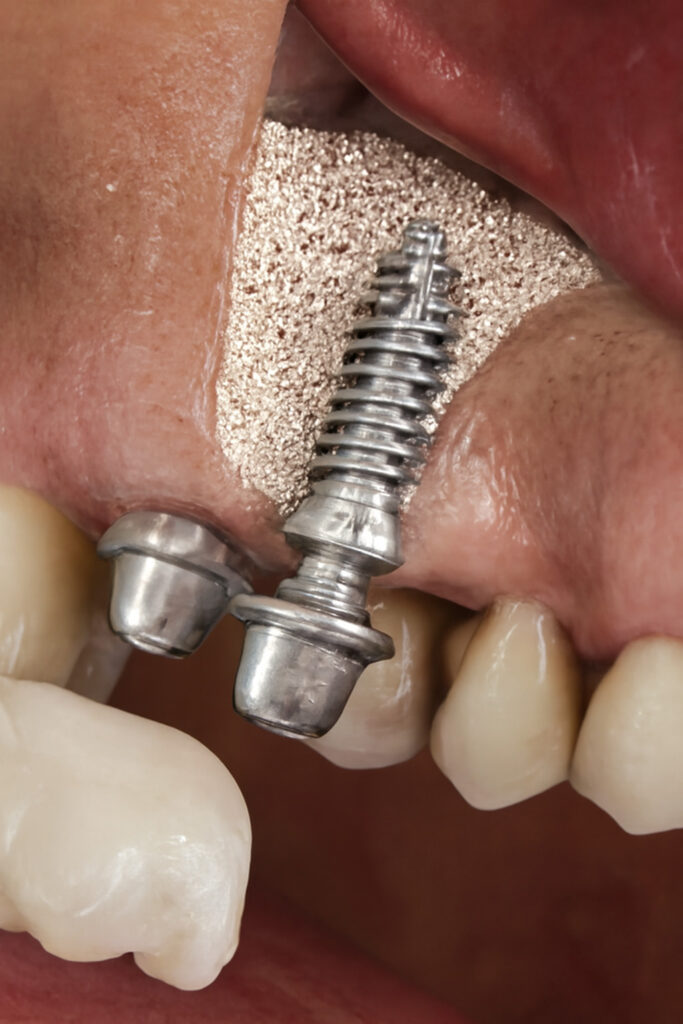
The sinus lift elevates the sinus membrane to make space for bone graft material. Surgeons commonly choose the lateral window technique. They create a small access in the lateral wall, gently detach the Schneiderian membrane, and fill the created void with bone graft.
The crestal approach offers a less invasive alternative when only minimal additional height is needed the bone graft goes in through the osteotomy site itself. Both methods allow new bone to form around and within the graft. Healing usually takes four to nine months before implants can be placed. The added bone height provides secure anchorage in the posterior maxilla where resorption occurs most frequently.
Ridge Augmentation to Restore Jaw Contour and Strength
Ridge augmentation widens or heightens the deficient alveolar ridge. Surgeons place bone graft material along the alveolar crest or lateral walls of the jaw to restore natural bone dimensions. Some defects respond to particulate grafts alone. Others require block grafts secured with fixation screws.
The material integrates gradually with host bone over several months. Patients regain proper ridge width and height so implants emerge at the correct angulation and crowns match adjacent teeth perfectly. The procedure also supports facial soft tissues — cheeks and lips maintain natural fullness rather than appearing sunken.
“This represents an overall ‘success’ rate of 96%, 97% for horizontally augmented ridges and 92% for vertically augmented ridges.”
Source: Fugazzotto PA (1998). Report of 302 consecutive ridge augmentation procedures. PubMed.
Bone Graft Materials Commonly Used Today
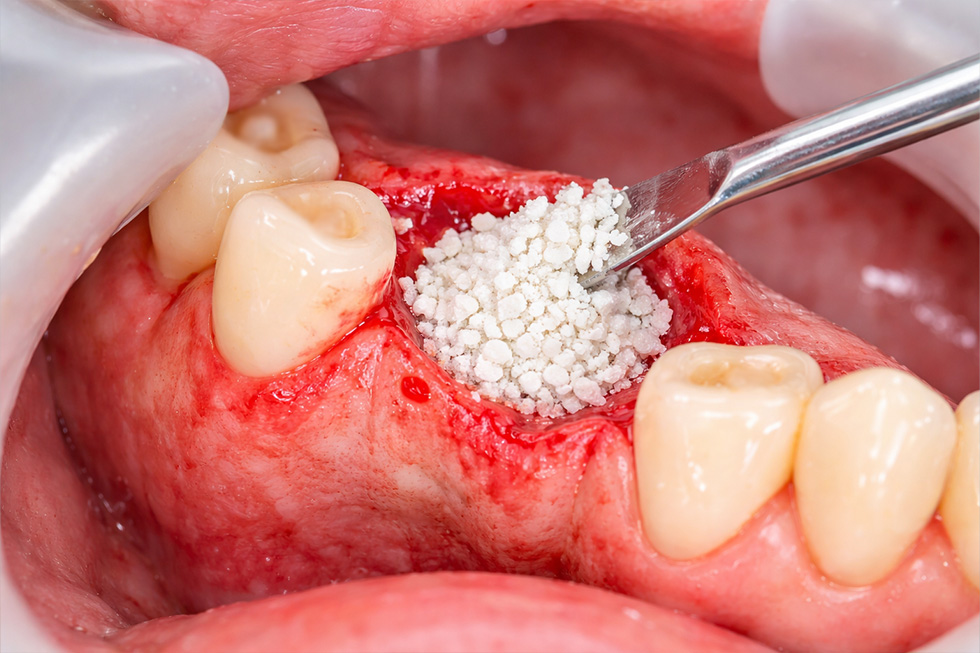
Four options cover most clinical needs. Autogenous bone harvested from intraoral sites or the iliac crest integrates rapidly since it carries living cells familiar to the body. Allograft from screened tissue banks has proven safe and effective for decades.
Xenograft processed from bovine sources serves as a stable scaffold that the host slowly remodels. Synthetic grafts based on hydroxyapatite or beta-tricalcium phosphate replicate bone mineral structure and resorb predictably as new bone replaces them.
Preparing for the Surgical Appointment
A few preparations simplify the experience. Discontinue non-essential blood thinners seven days prior unless the physician advises otherwise. Arrange transportation home because mild sedation often keeps things relaxed.
Have a light meal before arriving. Brush gently that morning and rinse with chlorhexidine. Bring an up-to-date medication list. Most patients relax quickly once seated and the routine steps begin.
The Day of Surgery Step by Step
Local anesthesia numbs the operative field completely. For sinus lift the surgeon reflects a flap, creates the lateral window, lifts the membrane, places graft, and closes the site.
Ridge augmentation follows a similar sequence — flap elevation, graft placement, membrane coverage when indicated, and tension-free closure. The entire visit typically lasts 60 to 90 minutes. Patients stay comfortable throughout.
Many bring headphones and listen to music. The procedure ends sooner than anticipated for most.
Immediate Recovery and Home Care
Swelling usually reaches its maximum on day two or three and subsides within one to two weeks. Ice packs applied intermittently control it well. Discomfort mimics a moderate extraction for the majority. Prescribed analgesics manage it effectively.
Soft, cool foods — yogurt, oatmeal, smoothies, scrambled eggs — feel easiest during the first seven to ten days. Straw use is avoided. Hot beverages wait until the graft stabilizes. Light activity helps circulation while strenuous exercise pauses until sutures settle and swelling decreases. Most return to routine activities within a few days.
Healing Timeline and Follow-Up Appointments
Remodeling starts almost immediately. Full maturation requires four to nine months before implant placement. Periodic check-ups every four to six weeks monitor incorporation. The grafted zone feels progressively firmer.
Patients sometimes note the area becomes denser than adjacent native bone. Diligent plaque control around the surgical site accelerates gingival healing and safeguards the developing bone.
In general, a healing period of 6-8 months is required between placement of the bone graft material and maturation of new bone.
Source: Kim YK et al. (2020). Sinus membrane elevation and implant placement. PMC/NIH.
Transition to Implant Placement and Long-Term Outlook
Once CBCT imaging confirms mature, dense bone the implant surgery proceeds routinely. Placement itself often takes under an hour. Many resume normal schedules the following day. The complete process from grafting to final restoration averages six to twelve months.
Clinical studies report success rates exceeding 90 percent for implants in augmented sites when maintenance is consistent. Chewing forces distribute evenly.
Facial profile remains supported. Patients smile without hesitation because the restoration feels and appears entirely natural.
At Dr. Nooshin Ghayoumi treatment plans receive thorough, individualized explanations. Sinus lift and ridge augmentation transform cases once limited by bone deficiency into predictable, esthetic outcomes. Patients who once doubted implants now chew, speak, and smile with full assurance.
Bone deficiency holding back dental implants? A consultation with 3D imaging clarifies possibilities quickly. Call 949-502-8844 or book online. The path to a strong, natural smile begins with one straightforward discussion.